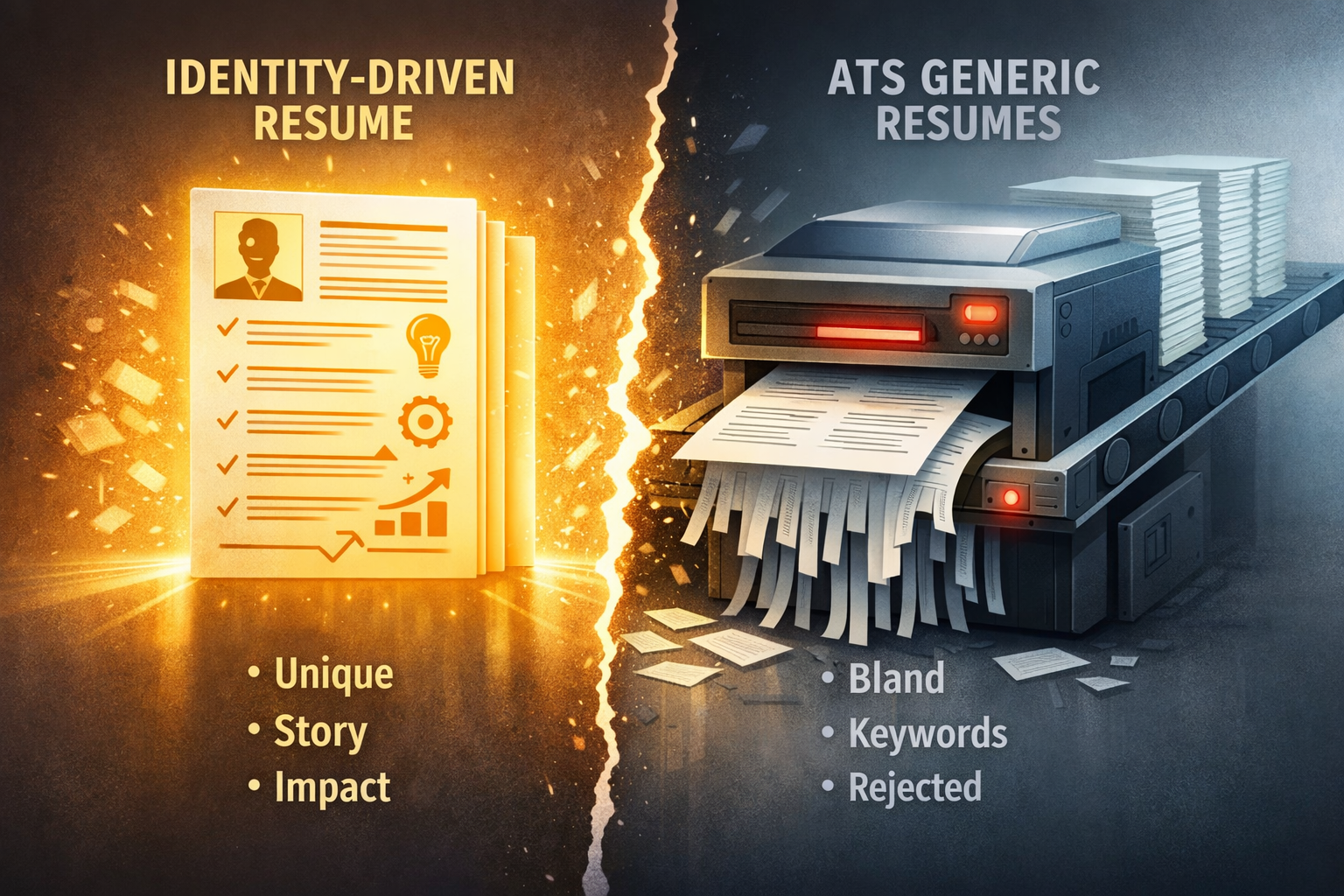
The Death of the Generic Resume: Why 2026 Hiring Systems Reject 70% of Candidates Before a Human Even Looks
Most people think their resume is being rejected because of formatting issues, PDF quirks, or missing keywords. But in 2026, the truth is far more complex — and far more frustrating. Modern hiring systems don’t reject resumes because they’re ugly or because they contain an icon. They reject them because they fail to communicate identity, clarity, intent, and narrative coherence.
In other words: the system isn’t rejecting your resume. It’s rejecting the version of you that your resume fails to express.
This article exposes the real reasons behind the 70% rejection rate, why generic templates no longer work, and how identity-driven resumes have become the new standard for surviving the hiring process.
1. The Story That Happens Millions of Times a Day
Picture this.
A highly capable candidate. Strong experience. Real projects. Solid metrics. A clean, ATS-friendly resume with no icons, no colors, no formatting tricks — everything “by the book.”
They apply for a role.
0.4 seconds later, they’re rejected.
Not because of the PDF. Not because of the font. Not because of the layout.
But because the system couldn’t detect:
- A clear professional identity
- A coherent narrative
- Evidence of trajectory
- Semantic alignment with the role
- Signals of intent
And the worst part? The candidate will never know. They’ll assume it was the format. Or the template. Or the lack of keywords. But the truth is deeper — and far more structural.
2. The Industry Lie Nobody Talks About
Resume builders, ATS optimizers, and template marketplaces have been selling the same promise for years:
“Use this template and you’ll pass ATS.”
But in 2026, this is simply not true.
Modern ATS systems don’t fail because of formatting. They fail because of semantic mismatch, narrative incoherence, and identity dilution. They’re not looking for keywords — they’re looking for signals.
Signals of clarity. Signals of intent. Signals of professional identity.
And generic templates cannot produce those signals.
3. The 5 Hidden ATS Filters That Kill 70% of Resumes
ATS systems in 2026 operate more like semantic classifiers than keyword scanners. They evaluate meaning, coherence, and alignment — not just text.
1. Semantic Mismatch
It’s not about stuffing keywords. It’s about matching the intent of the role. If your experience doesn’t reflect the underlying purpose of the job, the system flags it as irrelevant.
2. Narrative Incoherence
If your career story doesn’t make sense — if roles feel disconnected or your progression feels random — the system interprets it as noise.
3. Identity Dilution
Resumes that sound like everyone else’s lose power. The system can’t detect unique signals of expertise or direction.
4. Experience Fragmentation
Bullet points that lack context or impact create semantic gaps. The system can’t understand what you actually did.
5. Role-to-Role Misalignment
If your resume doesn’t demonstrate a logical transition into the role you’re applying for, the system rejects it instantly.
Here’s the truth nobody says out loud:
The ATS isn’t looking for words — it’s looking for identity.
4. Why Generic Templates Fail in 2026
Generic templates were designed for a hiring world that no longer exists. They were built to look clean, not to communicate identity. They prioritize aesthetics over clarity, structure over meaning, and uniformity over narrative.
Let’s compare:
- Traditional resume builders: visually appealing, repetitive, shallow, identity‑less.
- Identity-driven resumes: clear, intentional, narrative‑aligned, semantically rich.
The difference isn’t stylistic — it’s philosophical.
5. The New Resume Standard: Identity‑Driven Resumes
In 2026, the winning resume isn’t the prettiest one. It’s the one that communicates identity with precision. It’s the one that tells a coherent story, demonstrates craft, and aligns with the role’s intent.
This new standard is built on five pillars:
1. Story
Your resume must tell a clear, logical, intentional story about who you are and where you’re going.
2. Craft
Your skills must be expressed through evidence, not buzzwords.
3. Evidence
Impact must be measurable, contextual, and real.
4. Trajectory
Your past must logically lead to your next role.
5. Emotional UX
Your resume must feel clear, confident, and easy to understand — even to a machine.
6. Real Before/After Examples
Example 1:
Before: “Responsible for managing projects and coordinating teams.”
After: “Led cross-functional teams of 8–12 to deliver 14 projects on time, improving delivery efficiency by 22%.”
Example 2:
Before: “Worked with clients to understand requirements.”
After: “Translated ambiguous client needs into clear technical requirements, reducing rework by 30%.”
Example 3:
Before: “Improved processes.”
After: “Redesigned the onboarding workflow, cutting cycle time from 14 days to 6.”
7. The Future of Hiring: Identity > Keywords
The future of hiring is not about beating the system — it’s about communicating who you are with clarity and intention. Systems are evolving to detect deeper signals: narrative coherence, professional identity, and semantic alignment.
Identity-driven resumes aren’t a trend. They’re the new baseline.
And your mission — through BrightPath — is to restore the candidate’s voice in a system that has stripped it away.
8. Final Call to Action
If your resume doesn’t represent you, it’s not your fault. The system changed. The rules changed. And nobody told you.
Your identity deserves a tool that matches your level.
Let’s build that resume together.