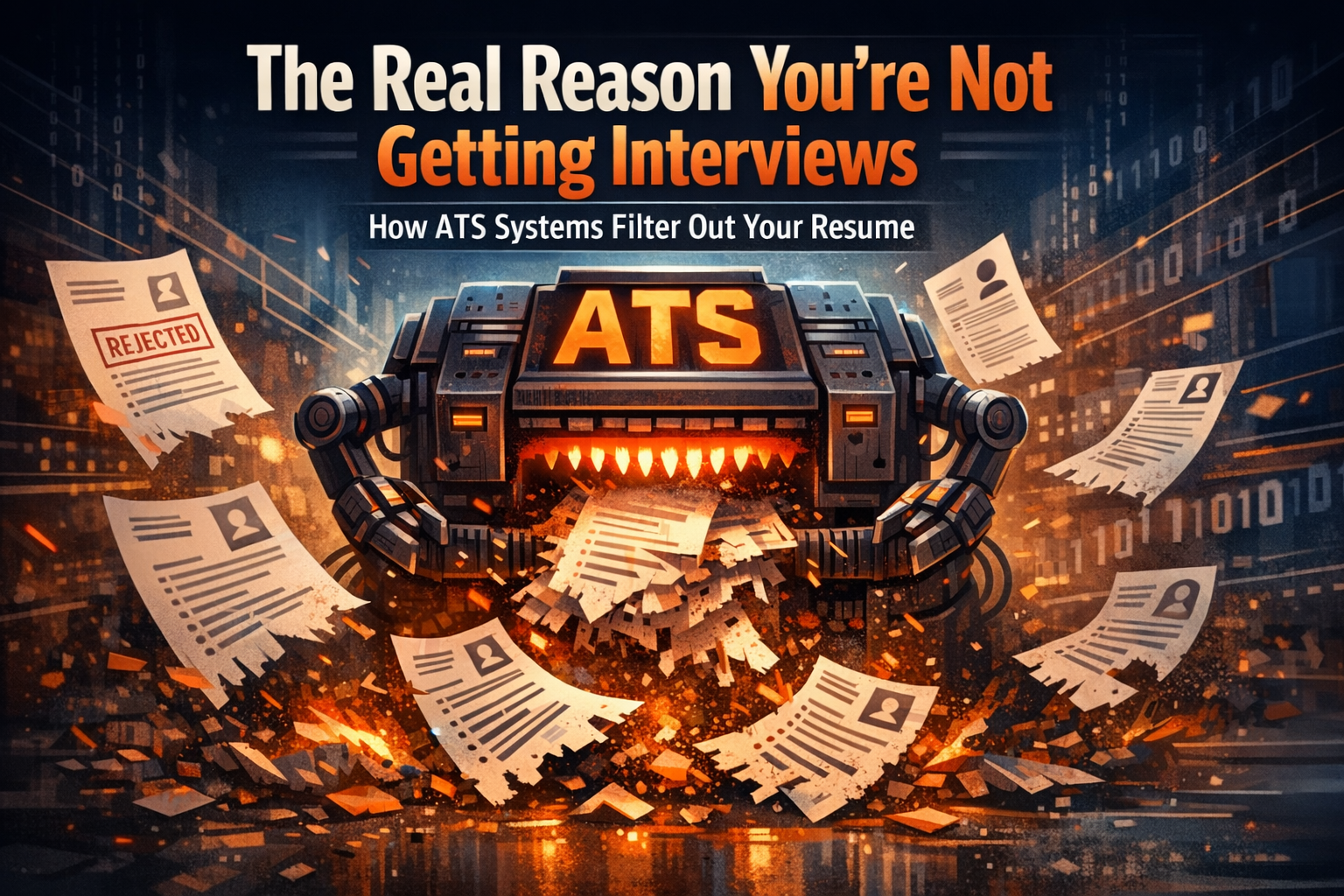
The Real Reason You’re Not Getting Interviews: How ATS Systems Filter Out Your Resume
Most candidates never get rejected by a human. They get rejected by a system.
You’re not crazy. The silence is real.
You’ve sent dozens, maybe hundreds of applications. You tweak your resume, you rewrite your summary, you add more bullet points, you even ask friends to review it. And still — nothing. No calls. No interviews. Just silence.
It’s easy to think: “Maybe I’m not good enough.”
But here’s the truth most people never hear:
your resume is probably being filtered out by an Applicant Tracking System (ATS) before a human ever sees it.
What is an ATS and why does it matter?
An Applicant Tracking System (ATS) is software that companies use to manage job applications. Instead of a recruiter reading every resume, the ATS:
- Scans your resume for keywords and structure.
- Scores how well you match the job description.
- Filters out resumes that don’t meet certain criteria.
In other words, the ATS acts like a gatekeeper. If your resume doesn’t pass its filters, it never reaches a human recruiter — no matter how qualified you are.
What our data shows from thousands of ATS scans
At BrightPath, we’ve analyzed thousands of resumes through our ATS Analyzer. The patterns are painfully clear. Most resumes aren’t failing because the candidate is weak — they’re failing because the resume isn’t built for how ATS systems actually work.
Here are the most common reasons resumes get filtered out:
- Missing critical keywords from the job description.
- Using vague, generic language instead of measurable impact.
- Formatting that confuses ATS parsers (columns, tables, graphics).
- Job titles that don’t match the role being applied for.
- Skills listed in a way the ATS can’t properly read or categorize.
Reason #1: Your resume doesn’t speak the same language as the job description
ATS systems are heavily keyword-driven. If the job description says “Senior Data Analyst – SQL, Power BI, stakeholder reporting” and your resume says:
“Worked with databases and dashboards to support business decisions.”
The system may not recognize you as a strong match — even if you’ve done the work. The problem isn’t your experience. It’s the language.
What ATS looks for:
- Exact or very close matches to key skills and tools.
- Job titles and responsibilities that mirror the posting.
- Clear alignment between your experience and the role’s requirements.
Reason #2: Your resume talks about tasks, not impact
Many resumes are full of responsibilities:
“Responsible for managing projects and coordinating with teams.”
ATS and recruiters both respond better to impact:
“Led a cross-functional project that reduced onboarding time by 30% and saved $120K annually.”
When your resume is vague, the system can’t confidently match you to high-impact roles. Clear, measurable outcomes help both ATS scoring and human decision-making.
Reason #3: Your formatting is beautiful for humans, but confusing for machines
Many modern resume templates look great — but they’re not built for ATS. Columns, icons, graphics, text inside shapes, and complex layouts can cause:
- Sections to be read in the wrong order.
- Skills or experience to be skipped entirely.
- Contact information to be misread or lost.
The result? A resume that looks premium, but gets scored as incomplete or irrelevant.
Reason #4: Your job titles don’t match the roles you want
ATS systems often use job titles as a strong signal of fit. If you’ve done the work of a “Product Manager” but your title was “Project Coordinator,” the system may not connect the dots.
You don’t need to lie about your title — but you can add clarity, for example:
- Project Coordinator (Product Management – SaaS)
- Operations Specialist (Supply Chain & Logistics)
This helps ATS understand the context of your role without misrepresenting your experience.
Reason #5: Your skills are hidden or poorly structured
Many candidates bury their skills inside paragraphs or scattered bullet points. ATS systems often look for a clear, scannable Skills section.
A stronger structure might look like this:
- Technical Skills: SQL, Python, Power BI, Excel, Azure
- Core Skills: Stakeholder management, data storytelling, forecasting, reporting
- Tools: Jira, Confluence, Salesforce, HubSpot
When your skills are organized this way, ATS can more easily match you to the job’s requirements.
How to stop getting filtered out by ATS
The good news: you don’t need to guess what ATS is doing. You can see it.
With BrightPath’s ATS Analyzer, you can:
- Upload your resume and a job description.
- Get an instant ATS score based on alignment.
- See exactly which keywords you’re missing.
- Identify weak, vague bullet points.
- Spot formatting issues that may confuse ATS.
Instead of sending your resume into the void and hoping, you get a clear, data-backed view of why you’re not getting interviews — and what to change.
A real example: from silence to interviews
One BrightPath user had applied to more than 80 roles with zero interviews. Their experience was strong, but their resume:
- Used generic language like “helped with” and “supported”.
- Had no clear Skills section.
- Didn’t mirror the language of the job descriptions.
After running their resume through the ATS Analyzer and applying the recommendations:
- They added missing keywords directly tied to the roles.
- They rewrote bullets to highlight measurable impact.
- They simplified formatting to be ATS-friendly.
Within two weeks, they received multiple interview invitations for roles they had previously been ignored for.
You’re not invisible. The system is just opaque.
If you’ve been feeling invisible, it’s not because you don’t have value. It’s because the system that stands between you and a recruiter is not designed to understand your story by default.
But you can learn its rules — and bend them in your favor.
You deserve to be seen by a human, not silently filtered out by an algorithm.
Run your resume through an ATS — before the employer does
Before you send your next application, don’t guess. Test your resume the same way the system will.
Upload your resume and a job description into BrightPath’s ATS Analyzer and get:
- An ATS compatibility score.
- A breakdown of missing keywords and skills.
- Suggestions to strengthen your bullet points and structure.
It takes less than a minute — and it can be the difference between silence and your next interview.
You’re not the problem. The way your resume is being read is.