What Recruiters Really See: The Hidden Architecture of Your LinkedIn Profile and How It Shapes Your Career Destiny
Your LinkedIn profile is not a résumé. It is not a digital business card. It is not a place to “list your jobs.” It is a living identity system — a dynamic, algorithmic, behavioral signal that determines whether you appear in recruiter searches, whether you get contacted, and whether you are perceived as a high‑value candidate before you ever apply to a job.
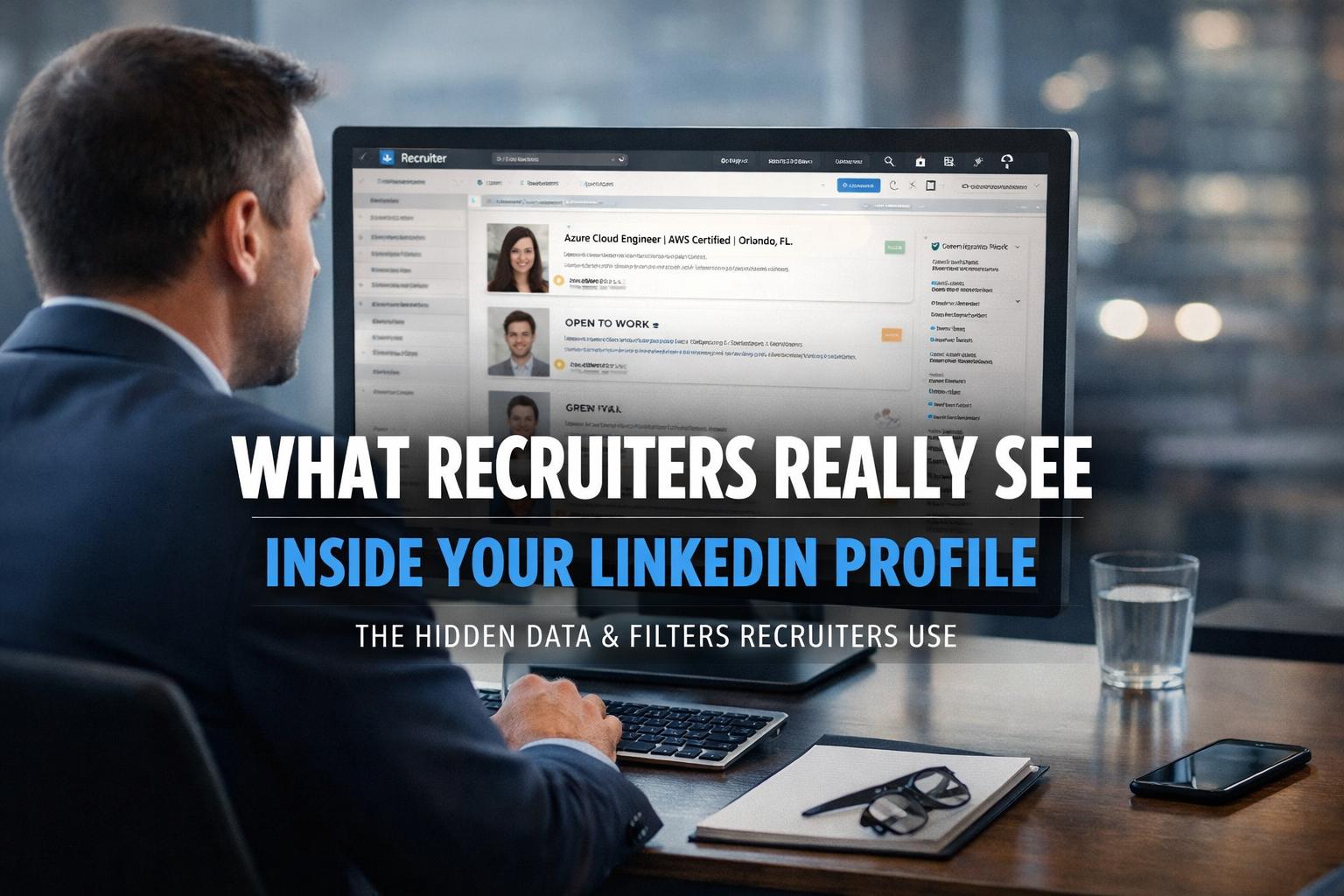
Most professionals never learn this. They treat LinkedIn as a passive archive of their career. Meanwhile, recruiters — especially those using LinkedIn Recruiter, the enterprise‑grade sourcing platform — see a completely different version of your profile. A structured, filtered, ranked, data‑driven representation of who you are.
This article is your backstage pass. A deep, emotionally resonant, technically accurate exploration of what recruiters actually see, how they interpret your profile, and how you can intentionally shape your digital identity to attract better opportunities.
The Hidden Reality: Recruiters Don’t Start With Applications
One of the most surprising truths shared by veteran recruiters — including those with decades of experience at Amazon, FedEx, Korn Ferry, and other global organizations — is this:
Recruiters rarely start by reading job applications.
They start by searching LinkedIn’s internal recruiter platform.
Before your résumé is ever opened, before your application is ever reviewed, your LinkedIn profile is already being evaluated. It is already competing. It is already ranking.
LinkedIn Recruiter is the first gateway. And your profile is the key.
Inside LinkedIn Recruiter: What They Actually See
LinkedIn Recruiter is not the public LinkedIn interface you use. It is a powerful sourcing engine with filters, structured data, ranking algorithms, and candidate insights that are invisible to everyday users.
Here is what recruiters actually see:
- Your headline — treated as a keyword‑rich identity statement.
- Your experience — parsed into structured job titles, industries, and seniority levels.
- Your skills — used as search filters and ranking signals.
- Your activity — yes, recruiters see how active you are.
- Your “Open to Work” status — visible only to recruiters.
- Your profile completeness — a major ranking factor.
- Your keywords — extracted from your About, Experience, Skills, and even Recommendations.
Recruiters don’t see your profile the way you do. They see a structured dataset. A candidate card. A snapshot of your professional identity distilled into signals.
And those signals determine whether you appear in search results — or disappear.
The Algorithmic Identity: Why Your Profile Ranks Higher or Lower
LinkedIn Recruiter uses a ranking system similar to search engines. When a recruiter searches for “Azure Cloud Engineer Orlando,” LinkedIn doesn’t show profiles randomly. It shows them based on relevance, completeness, keyword density, and behavioral signals.
Here are the biggest ranking factors:
1. Keyword Alignment
Your headline, About section, job titles, and skills must match the language recruiters use. If you write “Cloud Wizard” instead of “Azure Cloud Engineer,” you lose ranking power.
2. Profile Completeness
Profiles with missing sections rank lower. LinkedIn wants structured data — not empty fields.
3. Skills Matching
Recruiters filter by skills. If your skills list is incomplete, you vanish from filtered searches.
4. Job Title Standardization
Creative job titles hurt visibility. Standard titles help you appear in more searches.
5. Activity Signals
LinkedIn rewards active users. Posting, commenting, and engaging increases visibility.
6. Consistency Across Sections
If your headline says one thing but your experience says another, your ranking drops.
In other words: your profile is not just content — it is a search engine asset.
The Emotional Layer: What Recruiters Feel When They See Your Profile
Recruiters skim fast. They make emotional judgments in seconds. They look for clarity, confidence, and identity. They want to feel something when they see your profile — a sense of direction, purpose, and professional coherence.
Here is what triggers emotional resonance:
- A strong headline that communicates identity, not tasks.
- A narrative‑driven About section that shows intention and self‑awareness.
- Experience bullets that highlight impact, not responsibilities.
- Skills that match your career direction.
- Activity that shows you are engaged in your field.
Recruiters are human. They respond to clarity, confidence, and emotional coherence. Your profile should feel like a story — not a list.
The Identity Shift: Your Profile Is a Career OS, Not a Résumé
This is where BrightPath’s philosophy becomes essential.
Your LinkedIn profile is not a static document. It is a dynamic identity system — a Career OS that evolves with your goals, your skills, your narrative, and your emotional clarity.
When you treat your profile as a résumé, you limit yourself. When you treat it as a Career OS, you unlock visibility, opportunity, and alignment.
Here is how to shift your mindset:
1. Think in Identity, Not Tasks
Your headline should express who you are becoming — not just what you do.
2. Think in Narrative, Not History
3. Think in Impact, Not Responsibilities
Recruiters want to see outcomes, not job descriptions.
4. Think in Signals, Not Sections
Every part of your profile sends a signal. Make sure they align.
5. Think in Future, Not Past
Your profile should be optimized for the roles you want — not the roles you had.
The Practical Blueprint: How to Optimize Your Profile for Recruiter Visibility
Here is a step‑by‑step BrightPath optimization blueprint:
1. Craft a High‑Signal Headline
Use a combination of identity + role + specialization.
2. Write a Purpose‑Driven About Section
Tell a story of growth, clarity, and direction.
3. Standardize Your Job Titles
Use industry‑recognized titles to increase search visibility.
4. Add All Relevant Skills
Skills are search filters. Missing skills = missing opportunities.
5. Add Impact‑Driven Experience Bullets
Focus on measurable outcomes and transformation.
6. Stay Active
Engagement boosts visibility. Share insights, comment, and post.
The Emotional Truth: Your Profile Is Your First Impression
Before a recruiter reads your résumé, before they see your application, before they know your story — they see your LinkedIn profile.
It is your first impression. Your digital handshake. Your identity in motion.
And when you shape it with intention, clarity, and emotional resonance, you don’t just get noticed — you get chosen.
Final Reflection: You Are Not Competing With People — You Are Competing With Visibility
Most candidates are invisible. Not because they lack talent, but because their profiles lack clarity, structure, and identity.
Visibility is not luck. It is design.
And when you design your profile with purpose, you shift your career trajectory. You attract better opportunities. You become discoverable. You become undeniable.
This is the BrightPath philosophy: identity first, opportunity second.
Your LinkedIn profile is not a page. It is a gateway.
And now, you know how to open it.