Rejected in 6 Minutes? The Truth Behind Instant Resume Rejections and What Actually Happened
By BrightPath Team
Every job seeker has felt the sting of an instant rejection. You apply to a role you’re genuinely qualified for, hit “submit,” and within minutes—sometimes seconds—you receive the dreaded email:
“Thank you for your interest… we’ve decided not to move forward.”
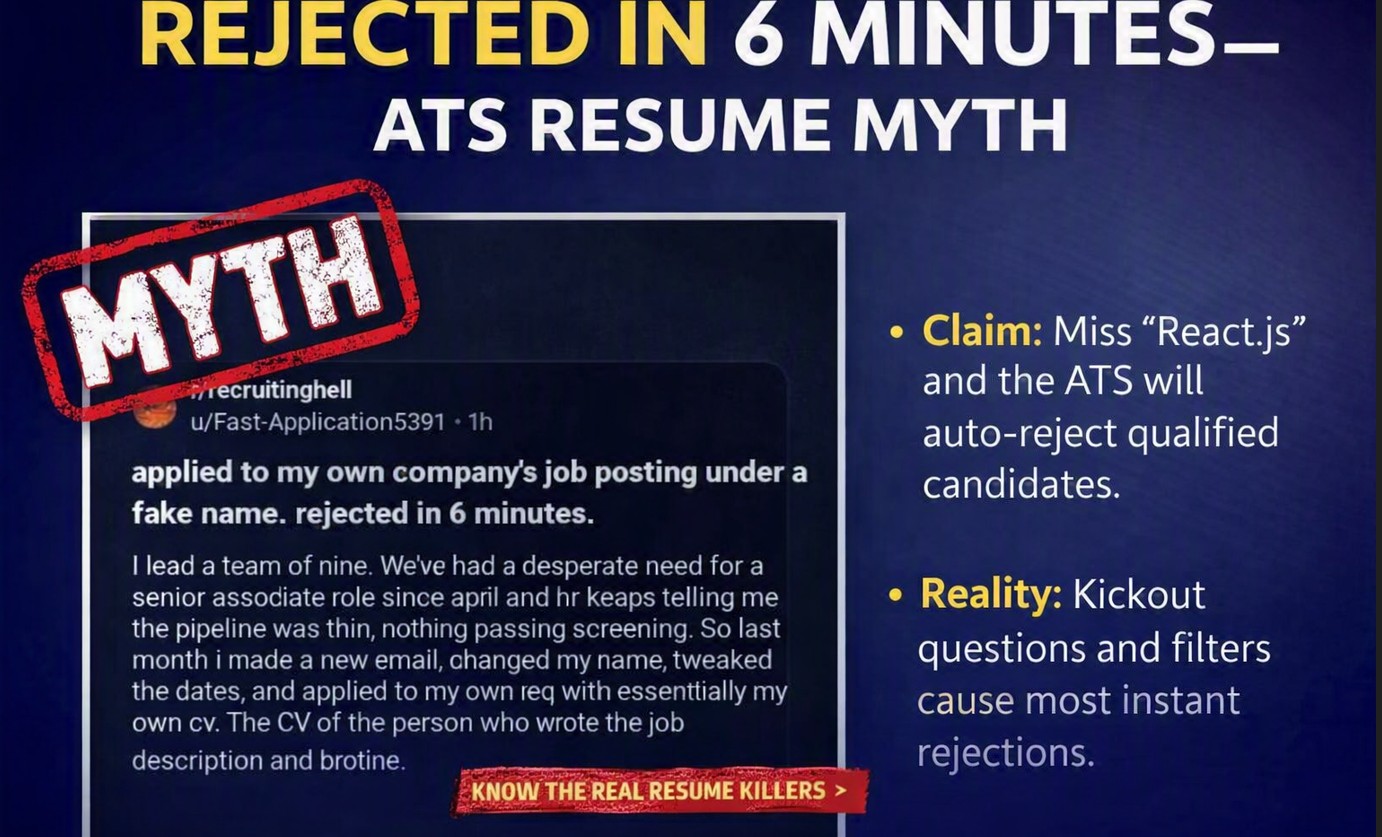
It feels personal. It feels unfair. And it feels impossible that anyone actually reviewed your resume in that time. Recently, a viral Reddit story reignited this frustration: a hiring manager claimed he applied to his own job posting under a fake name and was rejected in six minutes because his resume said “React” instead of “React.js.”
The internet exploded. People blamed AI. They blamed recruiters. They blamed ATS systems. They blamed the job market.
But here’s the truth: the story is almost certainly fake — yet the phenomenon it describes is absolutely real.
This article breaks down:
- The real reason instant rejections happen
- How ATS systems actually work (not the myths)
- Why keyword variations like “React” vs “React.js” rarely cause rejection
- The hidden filters that eliminate candidates automatically
- How to optimize your resume without keyword stuffing or AI hallucinations
- What hiring managers actually look for
By the end, you’ll understand exactly what happened in that viral story — and more importantly, how to prevent it from happening to you.
The Viral Reddit Story: What Supposedly Happened
The story goes like this: a hiring manager posted a job, then applied to his own posting using a fake identity to test the ATS. His resume was rejected in six minutes. The reason? The system allegedly filtered him out because he wrote “React” instead of “React.js.”
On the surface, it sounds like a cautionary tale about keyword precision. But when you dig deeper, the story falls apart.
Why the story is almost certainly fake
There are several red flags:
- Hiring managers rarely apply to their own postings — HR systems track internal applicants.
- Most ATS platforms do not reject candidates based on minor keyword variations.
- Instant rejections almost always come from kickout questions, not resume parsing.
- The timing (six minutes) aligns perfectly with automated filters, not human review.
But even if the story is fabricated, the underlying frustration is real. People do get rejected instantly. And they deserve to know why.
Instant Rejections: What Actually Causes Them
Let’s get one thing straight: AI is not rejecting your resume. Recruiters are not rejecting your resume in six minutes. And hiring managers are not sitting at their desks at 1 AM clicking “decline.”
Instant rejections come from one place:
Kickout Filters
Kickout filters are binary questions or requirements that automatically eliminate candidates who don’t meet specific criteria. These filters are set by HR or compliance teams — not by AI.
Common kickout filters include:
- Do you have work authorization?
- Do you meet the minimum years of experience?
- Do you have the required degree?
- Are you over 18?
- Are you willing to relocate?
- Do you have a valid driver’s license?
If you answer “no” to any required question, the system rejects you instantly — often within seconds.
These filters have nothing to do with your resume.
This is why the viral story doesn’t add up. A keyword mismatch wouldn’t trigger a six-minute rejection. A kickout filter would.
How ATS Systems Actually Work
There’s a lot of mythology around ATS systems. People imagine them as hyper-intelligent AI gatekeepers scanning resumes with surgical precision. In reality, ATS systems are much simpler.
ATS systems do three main things:
- Parse your resume into structured data (skills, experience, education).
- Bucket candidates into “strong fit,” “possible fit,” or “weak fit.”
- Apply filters based on job requirements.
Notice what’s missing?
ATS systems do not reject candidates based on AI judgment.
They don’t “decide” you’re unworthy. They don’t “hate” your resume. They don’t “punish” you for formatting choices.
They simply organize information and enforce rules set by humans.
Do Keywords Matter? Yes — But Not How You Think
Keywords matter, but not in the way most people believe. ATS systems are designed to match partial strings and variations of skills.
For example:
- React
- React.js
- ReactJS
- React JS
All of these typically match the same underlying skill.
So why do people get rejected?
Because keywords alone don’t determine fit. ATS systems look for:
- Context
- Experience depth
- Recency
- Relevance
Simply listing “React” ten times won’t help you. In fact, keyword stuffing can hurt you by making your resume look artificial or AI-generated.
The Real Problem: Lack of Contextual Evidence
Hiring managers don’t just want to see a keyword — they want proof you’ve used the skill in real scenarios.
For example:
Weak: React, Node.js, AWS
Strong:
“Built a React.js front-end for a healthcare analytics platform serving 50,000+ users, integrating Node.js microservices and AWS Lambda for real-time data processing.”
See the difference?
One is a list. The other is evidence.
Hiring managers can instantly tell whether your experience is real — especially during live coding tests or technical interviews.
Why AI-Generated Resumes Are Getting People Rejected
AI tools like ChatGPT and Claude are powerful, but they often hallucinate achievements, metrics, and responsibilities. Recruiters see thousands of resumes. They can spot AI-generated fluff instantly.
Common AI resume red flags include:
- Overly polished corporate language
- Unrealistic metrics (“improved efficiency by 300%”)
- Generic accomplishments repeated across roles
- Buzzword stuffing
- Responsibilities that don’t match job titles
These issues can push your resume into the “weak fit” bucket — even if you’re qualified.
How to Optimize Your Resume for ATS (Without Gaming the System)
Here’s what actually works:
1. Use natural keyword variations
Include both “React” and “React.js” if the job posting uses one or the other. Do this naturally within your experience bullets.
2. Mirror the job posting language
If the posting says “REST APIs,” don’t write “RESTful services.” Use their phrasing.
3. Provide contextual evidence
Show how you used each skill, not just that you know it.
4. Avoid keyword stuffing
ATS systems can detect unnatural repetition. Humans can too.
5. Keep formatting simple
Use standard fonts, no tables, no text boxes, no images.
6. Avoid AI hallucinations
If you use AI to help write your resume, always verify accuracy and remove exaggerated claims.
What Hiring Managers Actually Look For
Hiring managers care about three things:
- Can you do the job?
- Can you prove it?
- Can you communicate clearly?
They don’t care about:
- Fancy resume templates
- Overly complex language
- Buzzword clouds
- AI-generated achievements
They care about clarity, authenticity, and relevance.
The Real Lesson Behind the Viral Story
The story wasn’t about React vs React.js. It was about misunderstanding how hiring systems work.
Instant rejections happen because:
- You didn’t meet a required filter
- Your resume lacked contextual evidence
- Your keywords didn’t match the posting
- Your resume looked AI-generated
- Your experience didn’t align with the role
None of these are personal. None of them mean you’re unqualified. They simply mean your resume didn’t communicate your value effectively.
How BrightPath Helps You Avoid These Issues
At BrightPath, we’ve analyzed thousands of resumes and hiring workflows. We built our tools to solve the exact problems described in this article:
- Authentic, evidence-based resume writing
- Keyword alignment without stuffing
- ATS-friendly formatting
- Context-rich experience bullets
- Skill mapping based on real job postings
Our SOAR resume system helps you write content that hiring managers trust — not AI-generated fluff.
Final Takeaway
Instant rejections aren’t caused by AI judging your worth. They’re caused by filters, mismatched keywords, and lack of contextual evidence. The viral story was likely fake, but the frustration behind it is real.
If you want to stand out, focus on:
- Clear, authentic experience
- Natural keyword alignment
- Evidence-based accomplishments
- ATS-friendly structure
Do this consistently, and you’ll stop getting rejected in six minutes — and start getting interviews that matter.
Need help optimizing your resume?
BrightPath’s tools are built to help you stand out in a crowded job market. Explore our resume builder, portfolio tools, and career optimization systems at yourpathally.com.