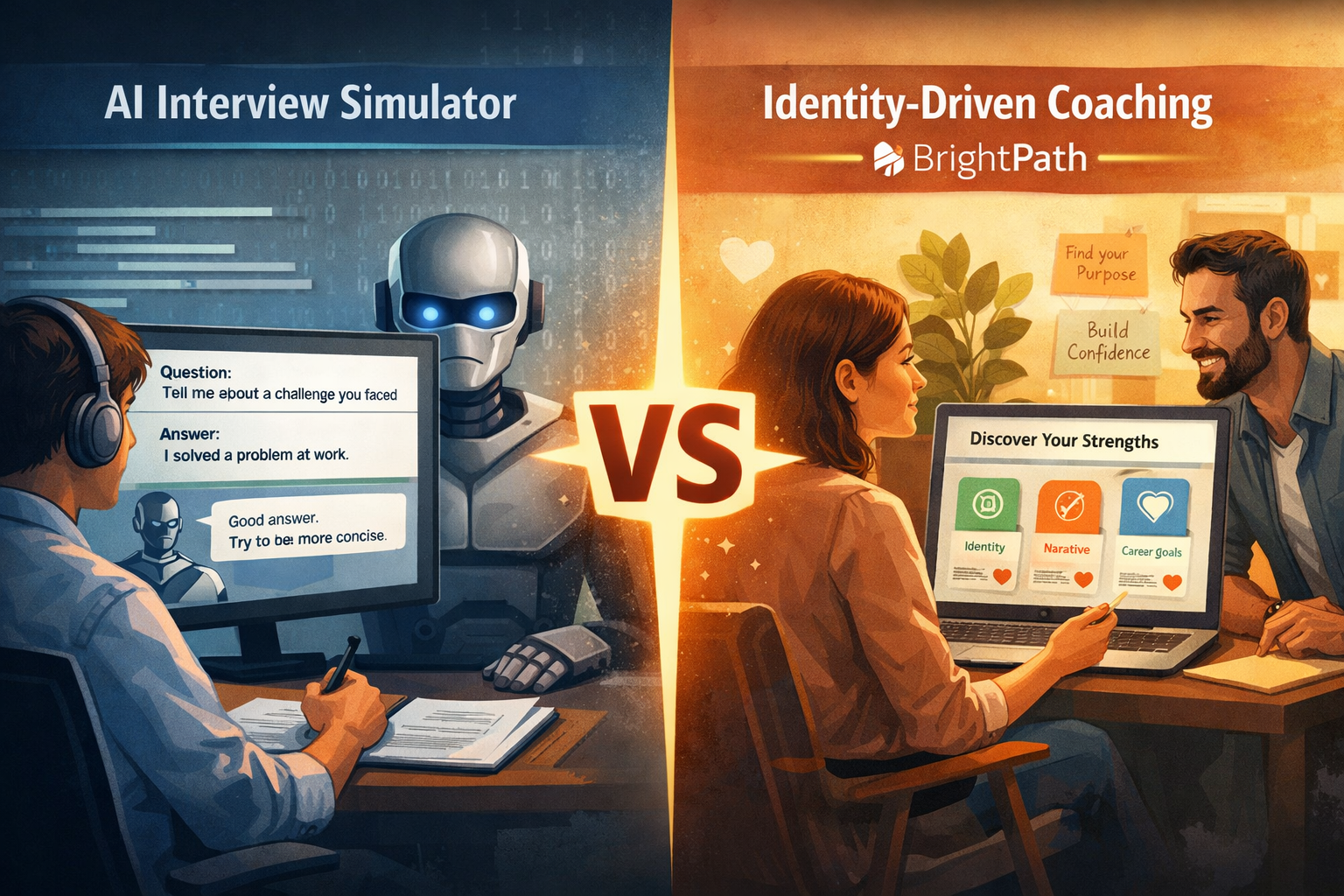
Why Interview Simulators Fail — And Why Identity‑Driven Coaching Is the Future of Career Growth
A deep exploration of the emotional, psychological, and narrative gaps that traditional AI interview tools cannot fill — and how a new category of “Identity‑Driven Interview Coaching” is redefining what it means to prepare for your next opportunity.
Introduction
Most people believe they fail interviews because they lack technical knowledge, perfect phrasing, or the “right” answer. But the truth is far more human — and far more overlooked.
Interviews are not exams. They are identity encounters.
They are moments where your story, your emotional clarity, your self‑perception, and your ability to communicate who you are collide with the expectations of another human being. And yet, the majority of AI interview tools in the market today — from fast simulators to technical prep platforms — treat interviews like mechanical drills.
They give you questions. You give them answers. They score you. You leave.
But nothing changes inside you.
You don’t gain clarity. You don’t gain confidence. You don’t understand your identity. You don’t transform.
This is the fundamental flaw in the current landscape of interview simulators — and it’s the reason a new category is emerging: Identity‑Driven Interview Coaching.
In this article, we will explore:
- Why traditional simulators fail
- The psychological and emotional layers of real interview performance
- The hidden narrative structures that shape how recruiters perceive you
- The difference between “practicing answers” and “building identity”
- Why the future belongs to platforms that integrate psychology, narrative, emotional UX, and human‑centered AI
- And how BrightPath (YourPathAlly) is pioneering this new category
This is not just another blog post. This is a manifesto for the future of career preparation.
1. The Problem With Today’s Interview Simulators
1.1 They treat interviews like quizzes, not human conversations
Most simulators — whether voice‑powered or text‑based — operate on a simple loop:
- Ask a question
- Capture your answer
- Provide generic feedback
This model assumes that interview success is about information recall.
But interviews are not about recall. They are about interpretation.
Recruiters interpret:
- Your energy
- Your confidence
- Your emotional clarity
- Your narrative coherence
- Your sense of purpose
- Your self‑awareness
- Your ability to connect dots
No simulator that focuses only on “answers” can teach you this.
1.2 They ignore the emotional dimension of performance
Interview anxiety is not a technical problem. It is an emotional one.
People fail interviews because they:
- Overthink
- Freeze
- Lose their narrative
- Forget their value
- Try to sound “correct” instead of authentic
Traditional simulators cannot detect emotional patterns. They cannot sense your internal state. They cannot help you regulate your energy.
They treat you like a machine. But you are human.
1.3 They provide feedback that is shallow and generic
Most simulators give feedback like:
- “Be more concise.”
- “Add more metrics.”
- “Use the STAR method.”
This is not coaching. This is templating.
Real coaching requires:
- Understanding your identity
- Understanding your emotional patterns
- Understanding your story
- Understanding your purpose
Simulators cannot do this because they are not designed to.
2. The Psychology Behind Real Interview Performance
To understand why simulators fail, we must understand what actually drives interview success.
2.1 Identity drives confidence
Confidence is not a personality trait. It is a byproduct of clarity.
When you know who you are, what you bring, and why you matter, confidence emerges naturally. When you don’t, no amount of practice questions will save you.
This is why people can practice 100 questions and still fail.
They practiced answers. They never practiced identity.
2.2 Emotional clarity shapes communication
Every answer you give in an interview is filtered through your emotional state.
If you feel:
- Uncertain → you ramble
- Insecure → you minimize your achievements
- Fearful → you over‑explain
- Disconnected → you sound robotic
Simulators cannot detect or correct emotional patterns. Identity‑driven coaching can.
2.3 Narrative coherence is more important than perfect phrasing
Recruiters don’t remember your exact words. They remember your story.
They remember:
- How you made them feel
- Whether your story made sense
- Whether you sounded grounded
- Whether you had purpose
Simulators cannot help you build a coherent narrative. They can only help you practice isolated answers.
3. The Hidden Narrative Structures Recruiters Look For
Every strong interview answer has three invisible layers:
- Identity — Who are you?
- Trajectory — Where are you going?
- Alignment — Why does this role fit your story?
Most candidates only answer the surface question. Great candidates answer all three layers simultaneously.
Simulators cannot teach this. Identity‑driven coaching can.
4. Why Identity‑Driven Coaching Is the Future
Identity‑Driven Coaching is not about practicing answers. It is about transforming the person giving them.
4.1 It integrates psychology
Understanding your emotional patterns is essential for interview success. Identity‑driven coaching helps you:
- Regulate anxiety
- Build emotional clarity
- Develop grounded confidence
4.2 It integrates narrative
Your story is your competitive advantage. Identity‑driven coaching helps you:
- Craft a coherent professional identity
- Connect your past to your future
- Communicate your value with purpose
4.3 It integrates emotional UX
How you feel while preparing affects how you perform. Identity‑driven coaching creates an environment that:
- Reduces friction
- Builds confidence
- Supports emotional flow
4.4 It integrates human‑centered AI
AI should not replace your identity. It should reveal it.
Identity‑driven coaching uses AI to:
- Reflect your strengths back to you
- Help you articulate your story
- Guide you through emotional and narrative clarity
5. How BrightPath (YourPathAlly) Is Creating a New Category
BrightPath is not a simulator. It is a Career OS built on identity, psychology, and emotional UX.
5.1 The Identity Engine™
BrightPath helps you uncover:
- Your core strengths
- Your emotional patterns
- Your professional identity
- Your narrative trajectory
5.2 The Emotional UX Framework™
Every interaction is designed to:
- Reduce anxiety
- Increase clarity
- Build confidence
5.3 The Narrative Builder™
BrightPath helps you craft:
- Your story
- Your positioning
- Your interview identity
5.4 The Identity‑Driven Interview Coach™
Instead of practicing answers, you practice yourself.
You practice:
- Clarity
- Purpose
- Identity
- Emotional grounding
This is the future.
Conclusion
Interview simulators fail because they treat interviews like mechanical exercises. Identity‑Driven Coaching succeeds because it treats interviews like human encounters.
The future of career growth belongs to platforms that understand:
- Identity
- Psychology
- Narrative
- Emotional UX
- Human‑centered AI
BrightPath is not competing with simulators. It is replacing them.
If you want to prepare for interviews in a way that transforms you — not just your answers — BrightPath is your ally.
Your identity is your advantage. Your story is your strategy. Your future is your path.